AI for Business Operations: Upgrade Systems, Not Headcount
AI for Business Operations: Why AI Won’t Replace Your Team—But It Will Replace Inefficient Processes
There’s a quiet anxiety running through a lot of small teams right now. Every other headline suggests artificial intelligence is coming for jobs, and it’s easy to picture a future where software quietly does the work your people do today. The fear is understandable. It’s also aimed at the wrong target.
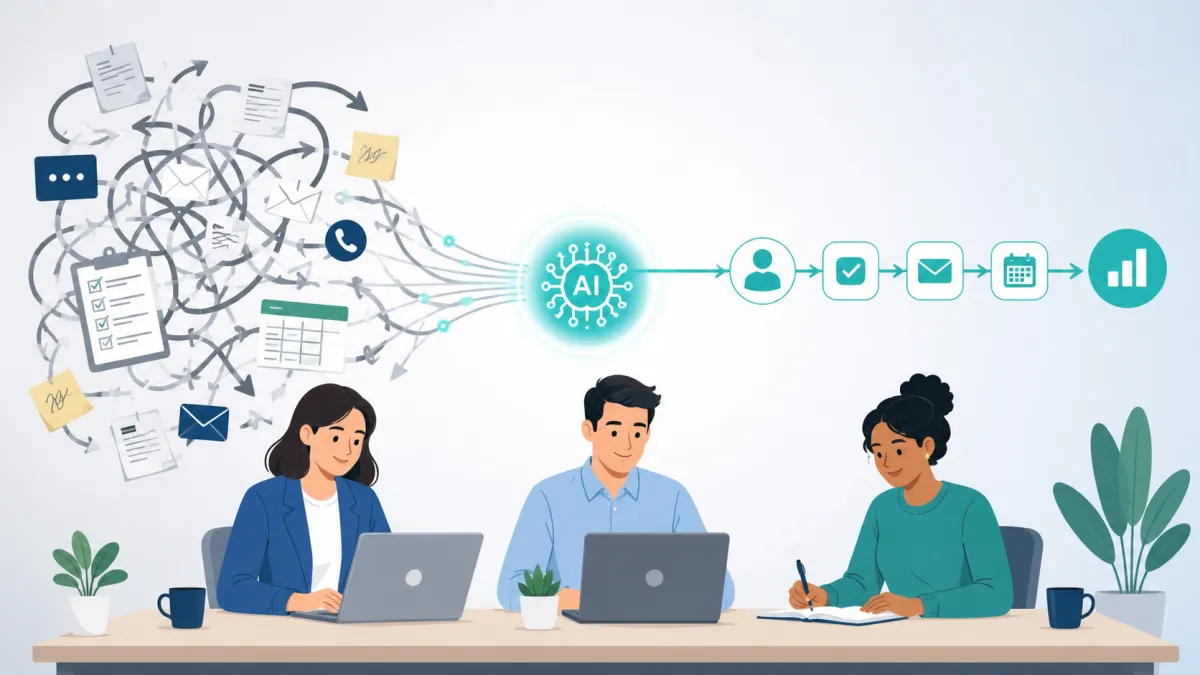
For most service-based businesses, clinics, agencies, and growing teams, AI for business operations isn’t a threat to the people doing the work. It’s a threat to the messy, manual, disconnected processes those people are forced to work around every day—the missed follow-ups, the copy-paste data entry, the leads that slip through the cracks at 9 p.m. on a Tuesday.
The businesses that win over the next few years won’t be the ones that swap staff for software. They’ll be the ones that use AI to remove the friction their teams have been absorbing by hand. This is a systems upgrade, not a people replacement. Let’s break down what that actually means.
The Fear Is Real. The Target Is Wrong.
Adoption is no longer the question. In its 2025 research on the state of AI, McKinsey found that roughly 88% of organizations now use AI in at least one business function—near-universal adoption. Yet only about 1% of leaders describe their rollouts as mature, meaning fully woven into how the business runs. You can read the full findings in McKinsey’s State of AI report.
That gap between adoption and value tells the whole story. AI is everywhere, but meaningful results are rare—because most businesses bolt AI onto broken processes instead of fixing the process first. AI amplifies whatever system it’s dropped into. Drop it into chaos, and you get faster chaos.
Here’s the reframe that changes everything: your people are not the inefficiency. The process is. A skilled receptionist isn’t the bottleneck—the fact that inquiries arrive across five channels with no unified way to capture them is the bottleneck. A good salesperson isn’t slow—they’re buried under manual admin that has nothing to do with selling. Fix the system, and the same people suddenly have room to do their best work.
What AI Actually Replaces
When you look closely at where automation delivers, it’s almost never the human judgment, relationships, or creativity that makes a business valuable. It’s the repetitive, rules-based work sitting underneath it. AI workflow automation quietly replaces things like:
Manual data entry and copy-pasting information between tools that don’t talk to each other
Chasing leads from memory or a sticky note instead of a structured follow-up sequence
Re-typing the same onboarding, confirmation, and reminder emails for every new client
Manually assigning and routing inquiries to the right person
Remembering to follow up—on the right day, through the right channel, before a lead goes cold
Rebuilding the same status reports and spreadsheets by hand every week
Notice what these have in common: they’re all processes, not people. The human still owns the relationship, the diagnosis, the pitch, and the judgment call. The system just handles the repetition around it. That’s the difference between replacing a team and freeing one.
Where the Value Actually Comes From: Redesigning the Workflow
This is the part most businesses miss. The value of AI doesn’t come from the tool. It comes from rewiring how the work flows. In the same McKinsey research, out of dozens of factors tested, redesigning workflows had the single biggest effect on whether a company saw real bottom-line impact from AI. The tool is not the transformation—the redesigned process is.
It’s also why so many companies get stuck in what practitioners call “pilot purgatory”: they launch a dozen disconnected AI experiments, but without fixing the underlying workflow, the impact stays isolated and never scales. The small group of high performers who capture serious value do the opposite—they redesign the process first, then automate it. McKinsey’s insights on gen AI in operations point to the same conclusion across industries.
For a small or growing business, the lesson is simple and freeing: don’t buy an AI tool and hope. Map the process, fix the process, then automate it. That sequence—systems first, software second—is the entire foundation of how we approach automation at NextLayer Co., because a clean process with modest automation beats a broken process wrapped in expensive tools every time.
The Hidden Cost of Inefficient Processes
If you want to see how much an inefficient process quietly costs, look at lead follow-up. The research here is blunt. Studies drawing on Harvard Business Review and MIT data show that roughly 78% of customers buy from the business that responds first—not the cheapest, not the most impressive, the first. Yet the average business takes around 42 hours to respond to a new inquiry.
The decay is steep. Leads contacted within five minutes are dramatically—often cited as around 21 times—more likely to qualify than those contacted just 30 minutes later. Every hour of manual delay is measurable revenue walking out the door. And this rarely happens because a team is lazy. It happens because the process depends on a human remembering, at exactly the right moment, while juggling ten other things.
Picture a small clinic. Its ads are working, and inquiries come in through the website form, Instagram DMs, and the phone. But the front desk is busy with patients, so a web inquiry sent at lunchtime doesn’t get a reply until the next morning. By then, the prospect has already booked with a competitor who answered in minutes. Nobody on that team did anything wrong. The process simply had no way to respond in the moment. That’s a systems failure, not a people failure—and it’s exactly the kind of gap automation is built to close.
A website that generates inquiries but has no system to capture, route, and follow up is a leaking bucket. This is precisely the kind of inefficiency AI removes: instant acknowledgment the moment a form is submitted, automatic routing to the right person, and follow-up reminders that never forget. The salesperson still closes the deal. The system just guarantees the conversation actually starts—which is where a connected website and funnel build and a follow-up workflow have to work as one.
More Marketing Won’t Fix a Broken System
A lot of businesses respond to slow growth by spending more on marketing—more ads, more posts, more traffic. But if the systems behind that marketing are weak, more visibility just means more leads leaking out of a bucket that already has holes in it. You end up paying to generate demand you can’t capture or convert.
This is the core idea worth sitting with: businesses don’t just need more marketing—they need better systems behind the marketing. Visibility, lead capture, follow-up, and operations have to work together as one connected flow. A great website with no follow-up is a brochure. A strong ad campaign with no capture system is a donation to the platform you’re advertising on. AI and automation matter here because they’re the connective tissue that turns scattered tools into a single growth system—one where every lead is caught, routed, and worked without anyone having to babysit the process.
What an AI-Augmented Team Actually Looks Like
Strip away the hype and the picture is grounded and practical. Imagine the same team you have today, minus the busywork that’s been draining them:
The receptionist is no longer re-keying appointment details into three systems, so they can focus on the patient or client actually in front of them.
The sales rep spends the day in live conversations instead of chasing cold leads and updating spreadsheets, because the pipeline updates itself.
The owner opens one clean dashboard instead of piecing the week together from notes, inboxes, and memory.
New clients move through a consistent onboarding flow automatically, so nothing depends on someone remembering step seven.
AI handles the repetitive substrate. People handle judgment, relationships, and creativity—the things that actually build trust and revenue. The net effect isn’t a smaller team. It’s the same team with more capacity, fewer dropped balls, and less burnout. That’s what operational efficiency really means: not doing more with less, but letting your people do the work that matters while the system carries the rest.
How to Approach AI Without Replacing Your Team
If AI is a systems upgrade, then the smart move is to treat it like one—methodically, not frantically. Here’s a practical, systems-first sequence any growing business can follow:
Map the workflow. Write down what actually happens from first inquiry to paying client. Where does work stall, get re-entered, or fall through? You can’t automate a process you can’t see.
Find the repetitive, rules-based tasks. Anything that follows a predictable “if this, then that” pattern—confirmations, reminders, data transfers, routing—is a strong automation candidate. Judgment-heavy work stays with people.
Connect the tools. Give the business one source of truth—usually a CRM—so information stops living in scattered inboxes and spreadsheets.
Automate follow-up and handoffs, not decisions. Let the system handle timing and consistency. Keep humans in charge of the relationship and the close.
Keep people on judgment and edge cases. The goal is to free your team’s attention for the high-value moments only they can handle well.
Measure what changed. Track response time, leads captured, and hours saved. Real operational efficiency shows up in numbers, not vibes.
This is the same progression behind our workflow and operations support: organize the manual processes first, reduce the repetitive work second, and only then layer in automation. Funnels, websites, marketing, and automation aren’t separate projects—they’re one connected growth system, and they perform best when built that way.
The Bottom Line
AI won’t replace your team. It will replace the inefficient processes that are quietly costing your team time, energy, and opportunities—the slow follow-ups, the manual data entry, the disconnected tools that force smart people to do dumb work.
The real opportunity in AI for business operations isn’t fewer people. It’s better systems behind the people you already have. Businesses that understand this will move from scattered tools and manual processes to connected infrastructure that captures more leads, follows up faster, and runs with far less friction—while their teams do more of the work that actually grows the business.
If your marketing is generating interest but your backend can’t keep up, the fix probably isn’t more effort from your team. It’s a better system behind them. Talk to NextLayer Co. about building the visibility, lead capture, and automation systems that let your people focus on what they do best.
Frequently Asked Questions
Will AI for business operations reduce my headcount?
For most small and growing businesses, no. The goal is to remove repetitive, low-value tasks so your existing team has the capacity to handle more clients, respond faster, and focus on relationships. It’s about adding capacity, not cutting people.
What’s the difference between AI and automation?
Automation follows fixed rules—if a form is submitted, send a confirmation and create a task. AI adds a layer of interpretation, such as drafting a reply, sorting inquiries by intent, or summarizing a conversation. In practice they work together: automation moves the work along, and AI handles the parts that need a bit of judgment. Both should simplify work, not complicate it.
Where should a small business start?
Start with the process that’s costing you the most right now—usually lead capture and follow-up. Get every inquiry into one place, automate the instant response, and build a simple follow-up sequence. Once that’s reliable, expand into booking, onboarding, and internal operations one step at a time.
Sources & Further Reading: