How AI Business Automation Creates a Calm, Scalable Business Engine
Most business owners don't need more leads. They need fewer fires.
The inbox is full. The CRM has 40 open deals in various states of neglect. Three follow-ups were supposed to go out yesterday. A new inquiry came in at 11 PM and nobody responded until the next afternoon. By then, the prospect booked with someone else.
This is what growth looks like without systems. More revenue, more chaos, and an owner who becomes the bottleneck for everything.
AI business automation fixes this. Not by adding more tools to your stack, but by removing you from the processes that shouldn't need you in the first place.
The Real Cost of Running Everything Manually
Manual operations don't just waste time. They create a specific kind of stress that compounds over the life of a business.
Every task that depends on a person remembering to do it is a task that will eventually be forgotten. Follow-up emails. Pipeline updates. Appointment confirmations. Re-engagement sequences for leads that went cold three weeks ago. These aren't hard tasks. They're just easy to skip when the day gets busy.
The result isn't one missed opportunity. It's a pattern. Leads fall through cracks consistently. Response times drift upward. The owner spends more time managing operations than doing the work that actually generates revenue.
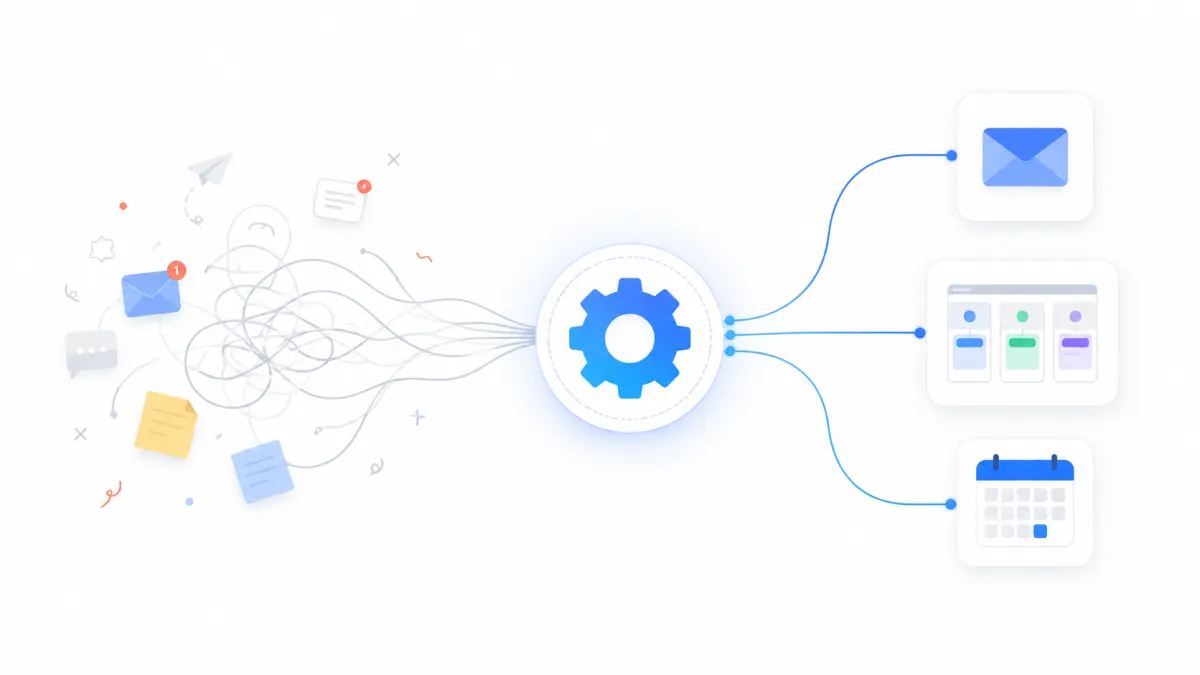
A business automation strategy addresses this at the structural level. Instead of hiring another person to manage the chaos, you build automation workflows that eliminate the chaos entirely.
What AI Business Automation Actually Looks Like
Forget the hype about AI replacing entire departments. For most service businesses, AI business automation is far more practical than that.
It looks like this:
Instant lead response
A prospect fills out a contact form at 9 PM. Within 30 seconds, they receive a personalized text and email. A follow-up sequence begins automatically. By the time you check your phone the next morning, the lead has already been nurtured, qualified, and offered a booking link.
This is exactly what a lead generation website should do. Forms connected to your CRM, triggering automation the moment someone acts. Not sitting in an inbox waiting for Monday morning.
Intelligent routing
Not every lead needs the same person. Automation evaluates the inquiry type, service requested, or location and routes it to the right team member with the right context. No one has to triage manually.
Pipeline management without babysitting
Deals move through your CRM based on actions, not manual drag-and-drop. When a proposal is sent, the stage updates. When a follow-up goes unanswered for three days, a re-engagement sequence triggers. When a deal closes, the onboarding workflow starts.
Appointment scheduling that handles itself
Booking links, calendar sync, confirmation emails, reminder texts, no-show follow-ups. The entire appointment lifecycle runs without anyone touching it.
Each of these is a point where most businesses lose time, lose leads, or lose their mind. Scalable systems handle all of them in the background.
Why This Is a Stress Reduction Play, Not Just a Growth Play
Here's what changes when your business automation strategy is actually working:
You stop being the safety net. When systems handle follow-up, routing, and scheduling, you're no longer the person who has to catch everything that falls. The system catches it.
Your team stops guessing. Clear workflows mean everyone knows what happens next. No ambiguity about whose job it is to follow up or when a lead should be contacted again.
Your weekends come back. Automation doesn't take days off. Leads that come in on Saturday get the same response quality as leads that come in on Tuesday at 10 AM.
Growth stops feeling dangerous. Without systems, scaling a business means scaling the chaos. With scalable systems in place, doubling your lead volume doesn't double your workload. It just means the system processes more.
This is the part that gets overlooked in most conversations about automation. It's not just about doing more. It's about operating with less friction, less anxiety, and fewer things that can go wrong.
The Difference Between Tools and Systems
Most businesses already have tools. A CRM. An email platform. A calendar app. Maybe a chatbot. The problem is that none of them talk to each other.
Tools in isolation create more work, not less. You end up manually transferring data between platforms, checking three dashboards to get one answer, and building workarounds for things that should be connected.
A business automation strategy connects those tools into a single system. The CRM triggers the email platform. The email platform updates the pipeline. The pipeline triggers the calendar. The calendar triggers the follow-up. One action cascades through the entire operation without anyone intervening.
That's the difference between owning software and owning a system. And it's the reason NextLayer builds funnels, websites, and automation as one connected system rather than three separate deliverables.
What to Automate First
If you're starting from scratch, don't try to automate everything at once. Start with the processes that cause the most pain:
Lead response. This is almost always the highest-impact automation. Speed to lead is one of the strongest predictors of conversion, and most businesses are slow. Automate the first touchpoint and the first three follow-ups.
Appointment reminders. No-shows cost real money. Automated confirmation and reminder sequences (email + SMS) reduce no-show rates significantly with zero ongoing effort.
Pipeline updates. If your team spends time dragging deals between stages manually, that's time wasted. Set up triggers that move deals based on actions taken.
Re-engagement. Leads go cold. It happens. But most businesses never circle back. A timed re-engagement sequence at 7, 14, and 30 days pulls a percentage of those leads back into the conversation automatically.
Each of these takes hours off your team's plate every week. Stack them together and you've built the foundation of a calm, scalable operation.
How to Know Your Business Is Ready
AI business automation works best when you already have some volume. If you're getting fewer than 10 leads per month, the priority is generating demand, not automating follow-up.
But if you're consistently getting inquiries and struggling to respond quickly, follow up consistently, or manage your pipeline without things slipping, you're past the point where manual processes can keep up.
Other signs you're ready:
You or your team spend more than 5 hours per week on tasks that follow the same pattern every time
Lead response time is measured in hours, not minutes
You've lost deals because someone forgot to follow up
Scaling feels like it would break your current operations
You're hiring to manage workload that a system could handle
If three or more of those sound familiar, you don't have a people problem. You have a systems problem. A free systems audit will show you exactly where the gaps are.
What the Build Process Looks Like
Once you decide to move forward, the process is straightforward. NextLayer follows a structured 7-step build process that starts with an intake form and a discovery call, moves through onboarding and system build, and ends with a full QA review and recorded walkthrough of everything that was built.
The sequence matters: website first, funnels second, automation third. Each layer connects to the one before it. By the time automation goes live, every form, every CRM tag, and every pipeline stage is already wired in.
Timelines depend on scope. Starter systems typically take 1 to 2 weeks. Growth-level builds run 2 to 4 weeks. You can see the full pricing and package breakdown to find the right fit for where your business is right now.
Building the Engine
The goal of AI business automation isn't to remove humans from your business. It's to remove humans from the tasks that don't need them.
Your team should spend their time on conversations, strategy, and relationship-building. Not data entry, manual follow-up, and remembering which lead needs a callback.
When the operational layer runs on its own, the business gets quieter. Not slower. Quieter. Fewer emergencies. Fewer dropped balls. Fewer late-night check-ins to make sure nothing fell through.
That's what a calm, scalable business engine looks like. Not more hustle. Better infrastructure.
NextLayer builds the lead conversion systems that make this possible. Funnels, websites, and automation connected from day one. If your business is generating leads but struggling to convert them consistently, get your free systems audit and we'll show you where the gaps are.